
A customer has asked for your carbon figures. Now what?
Carbon questions are turning up in more tenders and supplier forms. Here is a run-through of what your customers actually need from you, and how to answer them.
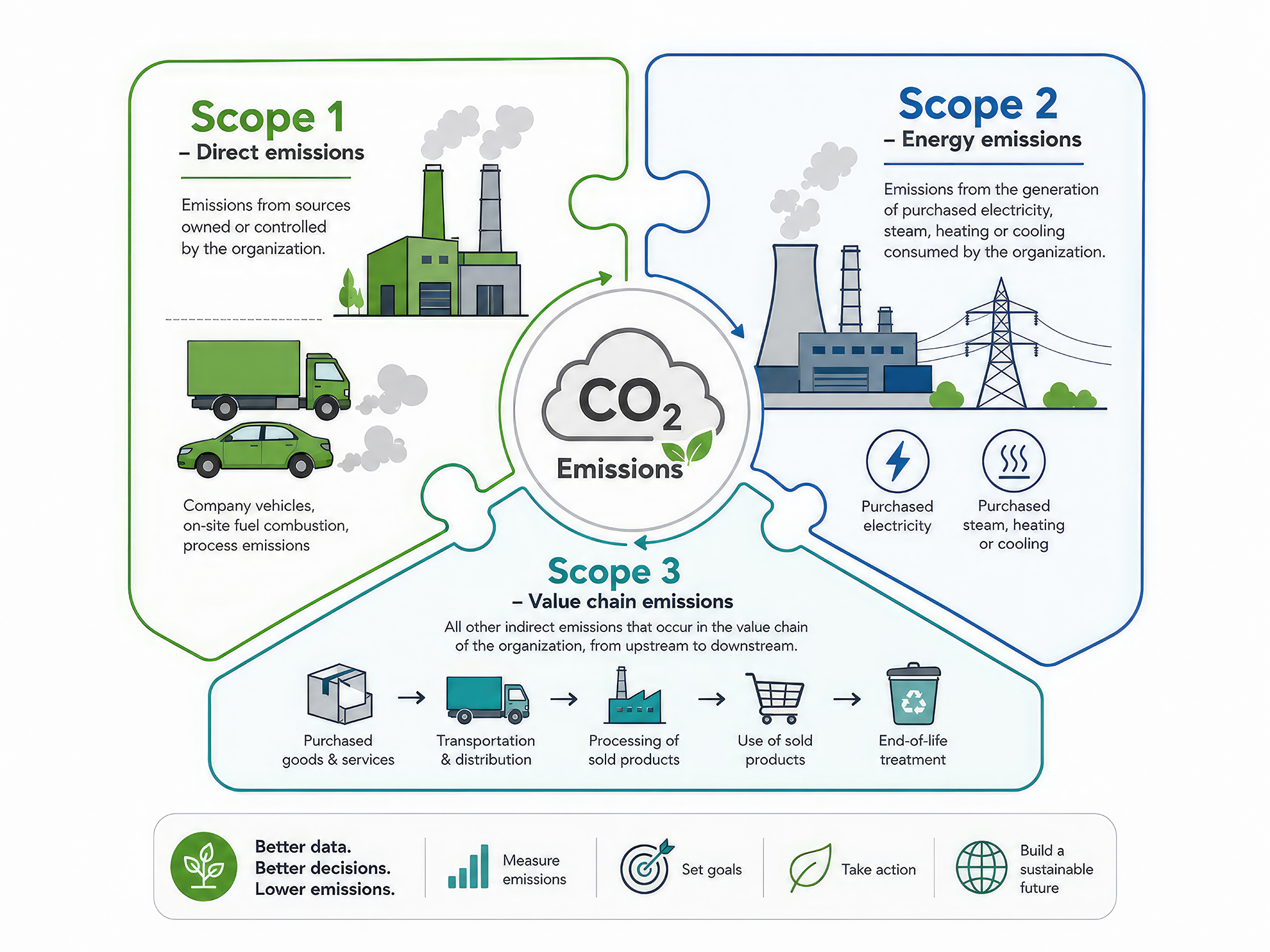
When a large company sets a carbon target, it has to count the emissions in its supply chain as well as its own. That supply chain footprint is called Scope 3, and for most organisations it is by far the biggest part. Government guidance puts it at up to 80% of the total.
So when your customer asks for your carbon figures, what they really want is your own emissions, so they can add them to theirs. You are not being asked to measure your whole supply chain. At least, not yet.
Most requests boil down to three things:
Some customers go further and ask for the carbon footprint of a specific product, or ask you to set a science-based target. But for most manufacturers, getting Scope 1 and 2 right and having a credible plan answers the question.
Annual bill totals will give you a number, but it is a blunt one. It can't tell a customer, or you, which site, process or product the emissions come from. It also won't show whether anything has changed since last year.
Metered data is far more convincing. With sub-meters on your main plant, you can report emissions by process or per unit of output, show a clear trend, and back up your reduction plan with evidence. It also tends to turn up savings, which is where the real payback is.
One food business we work with needed its Scope 1, 2 and 3 emissions measured across several sites so it could set science-based targets. We worked with the team to streamline data collection, audit the figures and prepare the targets.
One result stood out. Even though the business had grown, its emissions per kilogram of product stayed stable. That is exactly the kind of evidence customers look for, and it gave the business a solid base for its supply chain work.
If customers start asking for more, such as product footprints or supply chain figures, you will be building on solid ground rather than starting again.
We help manufacturers answer these requests properly:
Send it to us. We'll tell you what you can answer with the data you already have, what's missing, and the simplest way to fill the gaps.