For British manufacturers, energy costs are no longer just an overhead; they are a defining factor in profitability, investment and global competitiveness.
The Autumn Budget 2026 promises some relief, with electricity bill savings of up to 25% for eligible manufacturers, alongside wider measures to address energy costs and encourage investment.
25%
Potential reduction in electricity bills for eligible manufacturers
|
£35–40
Estimated saving per megawatt hour (MWh)
|
10,000+
Manufacturers expected to be supported by BICS
|
30 Nov
Initial BICS application deadline (2026)
|
But with support limited to qualifying businesses, will the Budget deliver meaningful relief across British industry, or leave many businesses facing the same pressures?
Pro Enviro Limited examines what the announcements really mean, who stands to benefit and where businesses can take action to reduce energy costs.
1. Electricity Bills: Up to 25% Savings for Eligible Manufacturers
The British Industrial Competitiveness Scheme (BICS) is expected to support more than 10,000 eligible manufacturers from April 2027. The Government estimates potential savings of £35–£40 per megawatt hour (MWh), equivalent to reductions of up to 25% in electricity bills. Importantly, this is not a blanket discount. Savings arise from exemptions from three electricity-related charges:
|
RO
Renewables Obligation
Exemption from April 2027
|
FiT
Feed-in Tariffs
Exemption from April 2027
|
CM
Capacity Market
Exemption from October 2027
|
RO and FiT exemptions are scheduled to begin in April 2027, followed by CM in October 2027. Retrospective support relating to 2026–27 is also expected.
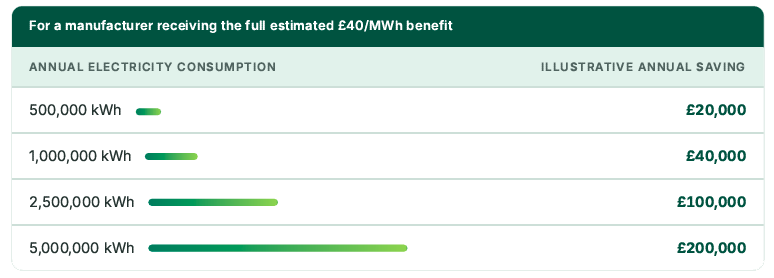
Eligibility is based on manufacturing activities and the proportion of electricity used for qualifying processes.
| ≥ 50% of site electricity used for eligible manufacturing may receive full exemption from the specified charges |
25–50% of site electricity used for eligible manufacturing may receive partial relief |
The initial BICS application deadline is 30th November 2026, making eligibility assessment an immediate priority.
2. Electricity Market Reform and Energy-Related Charges
The Budget reinforces plans to reduce the influence of volatile gas prices on electricity costs and introduces a Cost Control Framework at the 2027 Spending Review.
Several other measures could influence future energy expenditure:
- Climate Change Levy: The main electricity rate will be frozen from April 2028.
- Carbon Price Support: Planned removal from April 2028 could reduce costs within the electricity system.
- Gas Shipper Obligation: The Government has cancelled the proposed obligation, avoiding an additional potential charge on gas supplies.
These announcements may help control future costs, but they do not guarantee immediate reductions in commercial electricity or gas tariffs.
3. Capital Investment and Energy Efficiency
Changes to capital allowances may influence investment in qualifying energy-efficient equipment.
|
MAIN-RATE FIRST-YEAR ALLOWANCE
40% → 50%
From January 2027
|
MAIN-RATE WRITING-DOWN ALLOWANCE
12%
Reduced from April 2027
|
Manufacturers considering upgrades to machinery, compressed-air systems, motors and production equipment should review the applicable tax treatment.
However, existing reliefs such as the Annual Investment Allowance and full expensing may already provide more generous deductions.
Investment decisions should ultimately be based on measurable energy savings, productivity improvements and financial returns.
4 Years Simple Payback - Worked Example
Replacing an inefficient system at a cost of £100,000 that delivers £25,000 in annual net savings would provide a simple payback period of four years, before financing and tax effects.
4. Solar Energy and Infrastructure Investment
Although the Budget does not introduce a universal grant for commercial rooftop solar, on-site electricity generation remains an opportunity for businesses with suitable premises and significant daytime demand.
Solar installations can reduce grid electricity purchases and provide greater certainty over future energy expenditure.
The Budget also allocates additional capital to the National Wealth Fund, including an initial £2 billion towards the proposed Energy Wealth Fund.
This investment aims to support energy infrastructure and longer-term industrial competitiveness, although it should not be confused with direct grants for individual businesses.
5. What About Businesses That Do Not Qualify?
Many manufacturers, warehouses and commercial businesses will not qualify for BICS. For these organisations, improving energy efficiency remains one of the most practical ways to reduce operating costs.
£40k per year - Worked Example
A business consuming 2 million kWh annually at an avoidable electricity cost of 20p per kWh could save approximately £40,000 per year by reducing consumption by 10%.
Opportunities may include equipment upgrades, compressed-air efficiency, heat recovery, improved controls and better energy management.
Unlike temporary government relief, well-maintained efficiency improvements can deliver savings over many years.
6. What Should Businesses Do Now?
Businesses should prioritise five actions:
- Check BICS eligibility ahead of the 30th of November 2026 deadline.
- Review electricity and gas contracts to understand current costs and consumption.
- Identify energy-efficiency opportunities with measurable savings.
- Assess solar and equipment investment against payback periods and available tax relief.
- Develop a long-term energy strategy aligned with operational requirements.