
Two Months to Secure Up to a Quarter Off Your Electricity Bill
The first BICS application window runs from 1 October to 30 November 2026. Most of the work that wins a claim has to happen before it opens.
BICS opens its first application window on 1 October 2026 and closes on 30 November. Two months. The catch is that a claim rests on evidence that takes weeks to put together, so the window you really need to worry about is already open.
Applying in the first window does more than start your saving early. It qualifies you for a one-off credit, backdated to April 2026 and paid out in 2027. Only businesses confirmed eligible in Year 1 receive it.
Skip this window and the credit goes with it. You can still apply in a later year for the ongoing exemption, but the backdated payment does not come round again. Year 1 is the only year BICS pays twice.
BICS strips out the indirect policy costs loaded onto commercial electricity bills: the Renewables Obligation, Feed-in Tariffs and the Capacity Market. For qualifying sites the government puts the saving at up to a quarter of the bill, or an estimated £35 to £40 per MWh of eligible use.
It runs on a certificate. DBT confirms you are eligible, issues the certificate, and your supplier takes the charges off at source. It sits on top of other bill-relief schemes rather than replacing them. The RO and FiT exemptions start on 1 April 2027. The Capacity Market exemption follows on 1 October 2027.
A claim needs six consecutive months of billing data. It also needs a solid calculation of how much of your electricity goes into eligible manufacturing.
That calculation is where most applications are won or lost. Your main meter rarely separates eligible processing from offices, distribution and stockholding. To claim the full relief you usually need sub-metering, or a production-based calculation you can defend. That is not something you can assemble in the last fortnight before the window shuts.
Two tests, and you have to pass both.
On top of that, the site needs at least 33 MWh of grid-imported electricity a year, and you have to show genuine manufacturer status, with eligible processing kept separate from office, distribution and stockholding.
The part of a BICS claim that decides how much you get back is the eligible-proportion calculation. That is metering and half-hourly data work, and it is what we do. We run our own micro-metering surveys and half-hourly analysis in-house rather than farming it out, so the numbers behind a banding claim hold up when DBT examines them.
We are an engineering consultancy first. We understand what draws power on a manufacturing site, and how to separate eligible processing from offices, distribution and stockholding. That is the exact line a BICS application has to draw.
We have also spent years taking manufacturers through energy schemes and compliance work: energy audits, grant applications, Climate Change Agreements, ESOS and CBAM. Building evidence that stands up to official scrutiny is familiar ground.
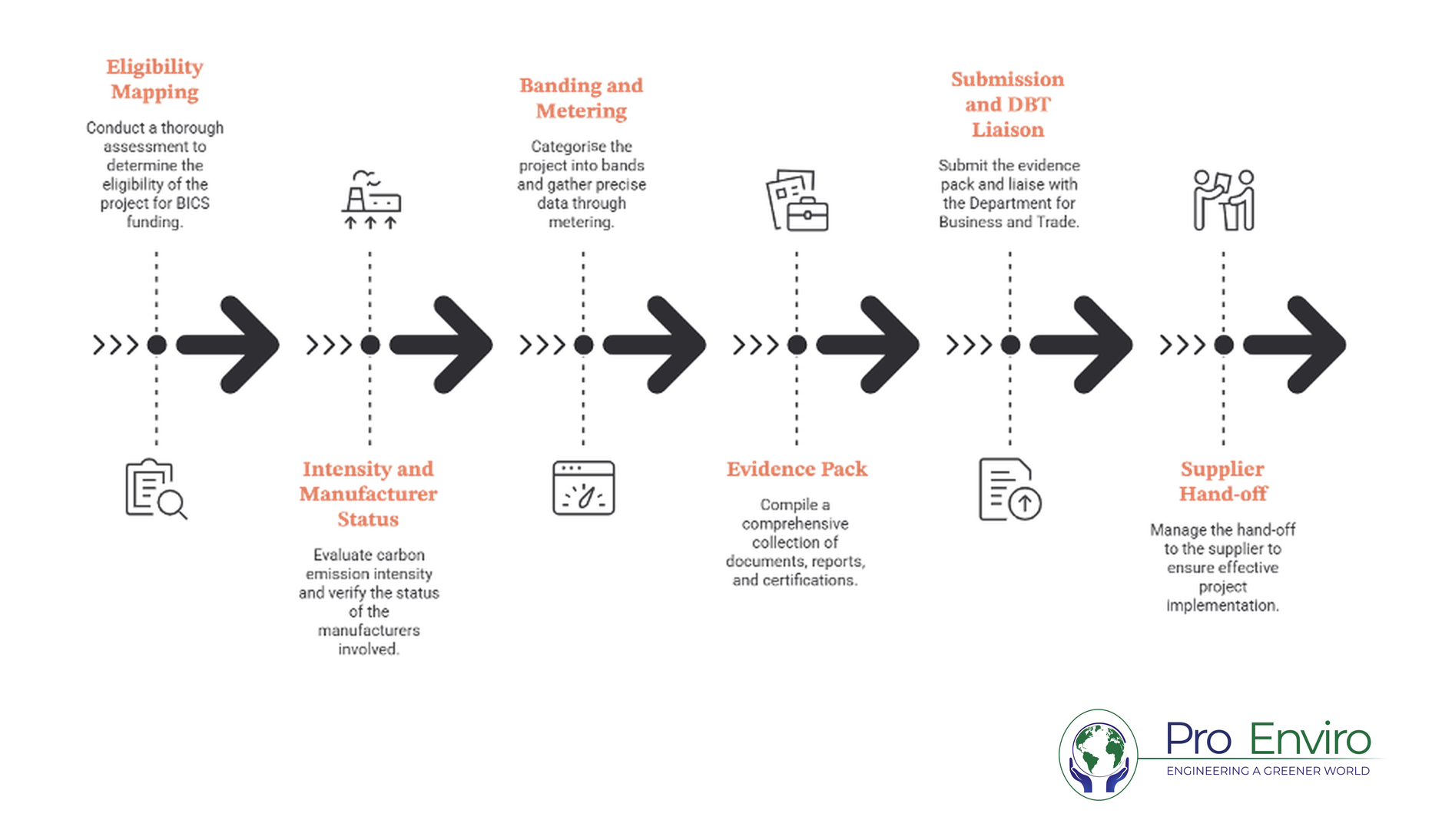
Pro Enviro handles BICS applications from start to finish, from the first eligibility check through to handing the exemption over to your supplier.
Get an application in during the first days of the window and you lock in both the recurring saving and the one-off credit. Give us your SIC code, your product range and twelve months of half-hourly data, and we can tell you quickly where you stand.
Book a free 20-minute qualification discussion. We will assess your qualification position and explain exactly what the application requires of your organisation, with no obligation.